cis-Jasmone
-
- Category :
Organic chemicals and Derivatives/Aroma compounds
- CAS NO : 488-10-8
- EC NO : 207-668-4
- Molecular Formula : C10H14O
- Main Specifications : 99% min
- Synonyms : (Z)-Jasmone;3-Methyl-2-(2-cis-penten-1-yl)-2-cyclopenten-1-on;Jasmone;3-Methyl-2-(2-pentenyl)-2-cyclopenten-1-one;3-methyl-2-(pent-2-en-1-yl)cyclopent-2-en-1-one;3-methyl-2-[(2Z)-pent-2-en-1-yl]cyclopent-2-en-1-one;3-methyl-2-[(2E)-pent-2-en-1-yl]cyclopent-2-en-1-one;2-[(2Z)-but-2-en-1-yl]-3-methylcyclopent-2-en-1-one;
Package: 25kg��,50kg 200kg
Uses : cis-Jasmone is mainly used in the fields of flavoring, agriculture, and scientific research.
Molecular Structure:
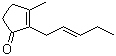
Product description:
What is the chemical of cis-Jasmone ?
Appearance: Colorless to pale yellow oily liquid;
Assay:99%min by GC�����;
IR Identity: conform to standard��;
HNMR: conform to standard�����;
carbon spectrum: conform to standard�;
Water by K. F.:0.5% max or as per the customer’s request�;
Loss on drying:0.5% max. or as per the customer’s request;
============================================================================
is-Jasmone is primarily used in the fields of flavoring, agriculture, and scientific research:
Flavoring Industry: It is used in high-end jasmine, citrus, and tea-scented perfumes and cosmetic fragrances. It can also be formulated into edible flavorings (such as jasmine and mint essences) that comply with GB 2760 and IFRA standards.
Agricultural Applications: As a plant defense inducer, it can activate crop insect-resistant genes and attract natural enemy insects. It also serves as a natural nematicide.
Scientific Research: It is used in neuroscience research (e.g., as an odorant receptor ligand) and is commonly found in standard reference materials or reagents for flavor and===============================================================================
Industrially, cis-jasmone is primarily synthesized through the following methods:
Cyclization-Methylation Method:
Using 7-decen-γ-one as the raw material, it undergoes cyclization with sodium hydroxide in methanol to form 2-(2-pentenyl)-3-methyl-2-cyclopenten-1-one (jasmonone).
Intramolecular Condensation Method:
Starting from γ-ketals, jasmonone is obtained by cyclization followed by methylation.
Metal Organic Condensation-Hydrogenation Method:
Methyl vinyl ketone reacts with hydrogen bromide to yield 2-bromoethyl methyl ketone. This compound condenses with an acetylene metal compound to form an acetal. It then reacts with the p-toluenesulfonate of (Z)-2-penten-1-ol. After treatment with chloric acid, cis-8-(+)-eno-5-yne-2-one is obtained. Finally, hydrogenation reduces it to 2,4-diketone, which undergoes intramolecular condensation in a dilute alkaline aqueous solution to yield cis-jasmone.
Natural Extraction and Isomerization:
Extracted from natural essential oils such as jasmine oil, neroli oil, and bergamot oil, and purified through isomerization to obtain high-purity cis-isomers (for reference only). fragrance.


 Search Product