Myosmine
-
- Category :
Others
- CAS NO : 532-12-7
- EC NO :
- Molecular Formula : C9H10N2
- Main Specifications : 99% min
- Synonyms : Myosmine;3-(1-Pyrrolin-2-yl)pyridine;5-23-06-00466 (Beilstein Handbook Reference);BRN 0119254;Pyridine, 3-(1-pyrrolin-2-yl)-;Pyridine, 3-(3,4-dihydro-2H-pyrrol-5-yl)- (9CI);3-(3,4-dihydro-2H-pyrrol-5-yl)pyridine;
Package: 25kg 50kg drum or bag
Uses : The main uses of Myosmine are concentrated in non-medical fields, including serving as a pharmaceutical intermediate for the synthesis of compounds such as nicotine, being applied in scientific research and chemical reagents (such as content determination
Molecular Structure:
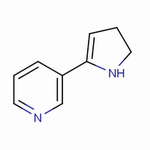
Product description:
Appearance: White to yellow powder or pale yellow crystals;
Assay:99%min by HPLC���;
IR Identity: conform to standard;
HNMR: conform to standard����;
carbon spectrum: conform to standard����;
Water by K. F.:0.5% max or as per the customer’s request�����;
Loss on drying:0.5% max. or as per the customer’s request�;
use:
The main uses of Myosmine are concentrated in non-medical fields, including serving as a pharmaceutical intermediate for the synthesis of compounds such as nicotine, being applied in scientific research and chemical reagents (such as content determination, pharmacological experiments, or metabolic studies), and being used in industrial production. It should be noted that it is not to be used for clinical diagnosis or treatment of humans or animals, and is limited to industrial or research purposes.
Pharmaceutical Intermediate: Used for synthesizing nicotine analogs and nicotinic acetylcholine receptor (nAChR) targeted drugs.
Scientific Reagent: Used as a standard for analytical methods such as HPLC, MS, NMR, supporting research on alkaloid compounds.
Tobacco Chemistry Research: Naturally present in nuts and tobacco products, it is an important reference substance for studying nicotine metabolism and addiction mechanisms.
Drug Impurity Reference Standard: Used for pharmaceutical quality control, particularly for impurity profile analysis of nicotine-like drugs.
Neuropharmacology Tool: It has low affinity for α4β2 nAChR (Ki ≈ 3300 nM) and is used for receptor function research


 Search Product