Levulinic acid
-
- Category :
Organic chemicals and Derivatives/Aroma compounds
- CAS NO : 123-76-2
- EC NO : 204-649-2
- Molecular Formula : C5H7O3
- Main Specifications : 99% min
- Synonyms : 4-Oxopentanoic acid;Levulinic acid,(4-Ketopentanoic acid;4-Oxopentanoic acid);4-oxovaleric acid;laevulic acid;Levulic Acid;4-Ketopentanoic acid;calcium bis(4-oxopentanoate);2-methyl-3-oxobutanoic acid;sodium 4-oxopentanoate;4-oxopentanoate;
Package: 25kg 50kg drum or bag
Uses : used in chemical intermediate, Medicine, Cosmetics and Agriculture: Pesticide intermediates, plant growth regulators
Molecular Structure:
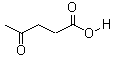
Product description:
What is the chemical of Levulinic acid?
Appearance: White plate-like crystals with hygroscopicity; After melting, it becomes a transparent light yellow liquid
Odor: Sweet, caramel flavor
Solubility: Easily soluble in water (675 g/L, 20 ° C), alcohols, and ether organic solvents; Insoluble in non-polar solvents such as aliphatic hydrocarbons, gasoline, kerosene, etc ;
Assay: 99% min by HPLC ;
IR Identity: conform to standard ;
HNMR: conform to standard ;
carbon spectrum: conform to standard ;
Water by K. F.:0.5% max or as per the customer’s request ;
Loss on drying:0.5% max. or as per the customer’s request ;
Melting point: 30–33 °C;
boiling point: 245-246 ° C (atmospheric pressure, lit.);
=============================================================================
main purpose
Chemical intermediates: used for the synthesis of gamma valerolactone, acetyl propionate, resins, fragrances, drugs, etc
Medicine: Used for the preparation of antibiotics, antiviral drugs, intravenous injections (such as calcium gluconate), anti-inflammatory drugs, etc
Food additive: As an edible flavoring (flavoring agent), FEMA number 2627, the maximum allowable dosage depends on the food category
Cosmetics: Used as pH regulators, skin conditioners, and moisturizers, with a maximum usage of 5% for resident products
Agriculture: Pesticide intermediates, plant growth regulators
Biofuel precursor: can be converted into biofuels such as ethyl acetate
===========================================================================
Synthesis route (main method)
Hydrolysis of furfural residue or corn cob with dilute acid:
Raw materials: cotton husks, corn cobs, residue of sugar formaldehyde (furfural residue) or waste yam residue.
Conditions: 10% dilute hydrochloric acid, solid-liquid ratio 1: 1.75, steam cooking at 0.2 MPa for 8-10 hours.


 Search Product