Hydroquinone
-
- Category :
Dyestuffs and Pigments
- CAS NO : 123-31-9
- EC NO : 204-617-8
- Molecular Formula : C6H6O2
- Main Specifications : 99% min
- Synonyms : 1,4-Benzenediol;Quinol;Hydroxyquinone;1,4-Dihydroxybenzene;benzene-1,4-diol;6,7-dihydroxy-2H-chromen-2-one;1,4-Dihydroxy benzene;1,4-Dihydroxy-benzol;
Package: 25kg 50kg drum or bag
Uses : as Intermediate of dyes, organic pigments, and fragrances and pesticide intermediate
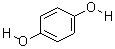
Molecular Structure:
Product description:
What is the chemical of Hydroquinone ?
Appearance: white to offwhite crstal powder ;
Assay: 99% min by HPLC ;
IR Identity: conform to standard ;
HNMR: conform to standard ;
carbon spectrum: conform to standard ;
Water by K. F.:0.5% max or as per the customer’s request ;
Loss on drying:0.5% max. or as per the customer’s request ;
===============================================================================
Application: Hydroquinone is an intermediate of herbicides quinazoline, fludioxonil, thiazole, oxadiazole, fludioxonil, and lactofludioxonil, as well as a pharmaceutical and dye intermediate. Application: Hydroquinone is mainly used as a photographic developer.
Hydroquinone and its alkylates are widely used as polymerization inhibitors in monomer storage and transportation processes, with a commonly used concentration of about 200ppm. Hydroquinone methyl ether is an intermediate of edible oil antioxidant BHA;
Hydroquinone dimethyl ether is an intermediate for dyes, organic pigments, and fragrances; Hydroquinone diethyl ether is an intermediate of photosensitive pigments and dyes. Hydroquinone is also used to produce N, N '- diphenyl p-phenylenediamine, which is an antioxidant and deodorizer used in rubber and gasoline. Use colorimetric method to determine phosphorus, magnesium, niobium, copper, silicon, arsenic, etc; Determination of iridium by polarography and volumetric method; Reductive agent of heteropolyacid; Reducing agents for copper and gold; Testing phosphates, tungstate, nitrate, nitrite, selenium, tellurium, etc; Developer; Antioxidant; Chemical fertilizer industry desulfurizer; Urea synergist.
===============================================================================
The production method of hydroquinone has always been based on the aniline method. Currently, industrial production has also developed the co production of hydroquinone, isopropylbenzene, and bisphenol A. Currently, China still uses the aniline method. 1. Aniline is oxidized to benzoquinone by manganese dioxide in sulfuric acid medium, and then reduced to hydroquinone by iron powder. The finished product is obtained through concentration, decolorization, crystallization, and drying. Industrial grade hydroquinone content ≥ 99%, photographic grade ≥ 99.5%. Raw material consumption quota: 1250kg/t aniline, 5500kg/t sulfuric acid (93%), 5950kg/t soft manganese ore powder (containing 60-65% manganese dioxide), 540kg/t iron powder (containing Fe ≥ 90%). 2. It is obtained by hydrogenation and heating using nitrobenzene as raw material. 2. Using phenol as raw material, catechol and hydroquinone are synthesized by hydrogen peroxide oxidation, and separated to obtain catechol and hydroquinone, respectively.


 Search Product