Ethyl heptanoate
-
- Category :
Organic chemicals and Derivatives/Aroma compounds
- CAS NO : 106-30-9
- EC NO : 203-382-9
- Molecular Formula : C38H72N2O12
- Main Specifications : 99% min
- Synonyms : Ethyl oenanthate;4-02-00-00960 (Beilstein Handbook Reference);AI3-24251;Aether oenanthicus;BRN 1752311;CCRIS 1344;Cognac oil;Enanthylic ether;Ethyl enanthate;Ethyl heptanoate (natural);Ethyl heptoate;Ethyl heptylate;Ethyl n-heptanoate;Ethyl oenanthylate;FEMA No. 2437;Grape oil;NSC 8891;Oenanthic ether;Oleum vitis viniferae;Wine oil;Ethyl enantate;Heptanoic acid, ethyl ester;(2R,3S,4R,5R,8R,10R,11R,12S,13S,14R)-2-ethyl-3,4,10-trihydroxy-3,5,6,8,10,12,14-heptamethyl-15-oxo-11-{[3,4,6-trideoxy-3-(dimethylamino)-beta-D-xylo-hexopyranosyl]oxy}-1-oxa-6-azacyclopentadecan-13-yl 2,6-dideoxy-3-C-methyl-3-O-methyl-alpha-L-ribo-hexopyranoside;
Package: 25kg�����,50kg 200kg
Uses : Flavorings: Widely used in the formulation of fruit, alcoholic beverage, and tobacco flavors. Food Additives: Used as edible flavorings in accordance with regulations for products such as chewing gum, baked goods, cold drinks, soft drinks, and alcoholic b
Molecular Structure:
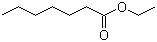
Product description:
What is the chemical of Ethyl heptanoate ?
Appearance: Colorless transparent liquid���;
Assay:99%min by GC�����;
IR Identity: conform to standard�;
HNMR: conform to standard����;
carbon spectrum: conform to standard;
Water by K. F.:0.5% max or as per the customer’s request���;
Loss on drying:0.5% max. or as per the customer’s request���;
==============================================================================
Flavorings: Widely used in the formulation of fruit, alcoholic beverage, and tobacco flavors. Food Additives: Used as edible flavorings in accordance with regulations for products such as chewing gum, baked goods, cold drinks, soft drinks, and alcoholic beverages. Organic Synthesis: Served as intermediates or reagents with applications in the fields of pharmaceuticals and materials.
===============================================================================
Main Synthesis Methods of Ethyl Heptanoate:
Direct Esterification of Heptanoic Acid with Ethanol:
Under the action of an acidic catalyst (such as concentrated sulfuric acid), heptanoic acid reacts with ethanol to undergo esterification, producing ethyl heptanoate and water. After purification steps such as water washing and fractional distillation, high-purity product is obtained.
Synthesis via Oxidation of 2-Octanol to Mixed Acids:
2-Octanol is oxidized with nitric acid to generate a mixed acid primarily consisting of hexanoic acid and heptanoic acid. The mixed acid is then fractionally distilled to separate heptanoic acid. Heptanoic acid is subsequently esterified with ethanol under sulfuric acid catalysis. Finally, water washing and fractional distillation yield ethyl heptanoate.
The reaction conditions are mild and the operation is simple. By controlling the ratio of reactants and removing the generated water, the esterification yield can be improved. The product purity can reach ≥98%, meeting the standards for food flavoring and industrial grades. (For reference only)


 Search Product