Cinnamic alcohol
-
- Category :
Organic chemicals and Derivatives/Aroma compounds
- CAS NO : 104-54-1
- EC NO : 203-212-3
- Molecular Formula : C9H10O
- Main Specifications : 99% min
- Synonyms : 3-Phenyl-2-propene-1-ol;3-Phenyl-2-propen-1-ol;Cinnamic alcohol;3-phenylprop-2-en-1-ol;(2Z)-3-phenylprop-2-en-1-ol;(2E)-3-phenylprop-2-en-1-ol;3-phenylpropan-1-ol;(E)-3-phenylprop-2-en-1-ol;
Package: 25kg���,50kg 200kg
Uses : used to prepare strawberry, lemon, apricot, peach, raspberry, plum and other fruit type edible essence;
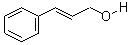
Molecular Structure:
Product description:
What is the chemical of Cinnamic alcohol ?
Appearance: Colorless to pale yellow liquid with a sweet aroma similar to hyacinth and cream ;
Assay:99%min by GC ;
IR Identity: conform to standard ;
HNMR: conform to standard ;
carbon spectrum: conform to standard ;
Water by K. F.:0.5% max or as per the customer’s request ;
Loss on drying:0.5% max. or as per the customer’s request ;
boiling =============================================================================
Main purpose
Spice industry:
It is used to prepare strawberry, lemon, apricot, peach, raspberry, plum and other fruit type edible essence;
It is the key ingredient for preparing narcissus, rose and other floral essence;
Often used in conjunction with phenylacetaldehyde to enhance aroma persistence
Cosmetics and daily chemical products:
Used as fixative and modifier, widely used in soap essence and cosmetics essence;
The highest historical usage of resident products is 0.0051167%
In the field of medicine:
It is an important intermediate for the synthesis of drugs such as Naoyizi, Flunarizine, Torimifene, Natifene, etc
Has anti-tumor activity and has been used in clinical research on blood cancer, uterine cancer, ovarian cancer, esophageal cancer, etc
Food additives:
============================================================================
Synthetic route
The main industrial synthesis methods include:
Cinnamaldehyde reduction method (most commonly used):
Using cinnamaldehyde as raw material, reduction can be achieved with a yield of ≥ 90% under the catalysis of aluminum benzyl alcohol;
Reaction conditions: 180 ° C, vacuum distillation to separate the product
.Natural extraction method (saponification method):
Extracted from natural resins such as Suhe Xiangzhi and Peruvian Xiangzhi;
Heat saponification with 10% NaOH solution for 5 hours, then extract with ether and purify by vacuum distillation
.Green restoration method:
Reduction of cinnamaldehyde using potassium borohydride at pH 12-14 without solvent residue, more environmentally friendly
point: 249-258 ° C (under normal pressure);


 Search Product