Cinnamic acid
-
- Category :
Organic chemicals and Derivatives/Aroma compounds
- CAS NO : 621-82-9
- EC NO : 205-398-1;210-708-3
- Molecular Formula : C9H8O2
- Main Specifications : 99% min
- Synonyms : trans-3-Phenylacrylic acid;trans-3-Phenyl-2-propenoic acid;trans-Cinnamic acid;(2E)-3-phenylprop-2-enoic acid;Cinnamic acid;3-Phenylacrylic acid;Phenylacrylic acid;3-phenylprop-2-enoic acid;2-{[(3alpha,5beta,6beta,7beta,8xi,9xi,14xi)-3,6,7-trihydroxy-24-oxocholan-24-yl]amino}ethanesulfonic acid;(2E)-3-phenylprop-2-enoate;(2Z)-3-phenylprop-2-enoic acid;β-phenylacrylic acid;(E)-Cinnamic acid;Natural trans-Cinnamic acid;
Package: 25kg 50kg drum or bag
Uses : ood industry: as a food flavor
Molecular Structure:
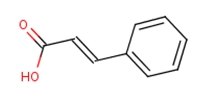
Product description:
What is the chemical of Cinnamic acid?
Appearance: White to slightly yellow crystalline powder, or white monoclinic crystals, with a slight cinnamon aroma.
Solubility: Slightly soluble in water (solubility at 25 ℃ is about 0.1-0.5 g/L), easily soluble in organic solvents such as ethanol, ether, chloroform, acetone, benzene, etc.
Stability: Stable at room temperature, but may sublime or decompose at high temperatures (>160 ℃); Insoluble in cold water, sensitive to strong oxidants. ;
Assay: 99% min by HPLC ;
IR Identity: conform to standard ;
HNMR: conform to standard ;
carbon spectrum: conform to standard ;
Water by K. F.:0.5% max or as per the customer’s request ;
Loss on drying:0.5% max. or as per the customer’s request ;
Melting point: 133–135 °C;
==============================================================================
main purpose
Food industry: as a food flavor (permitted in GB 2760 – 1996), it is used to prepare essence such as cherry, apricot, honey, cinnamon, etc; Can also be used as a natural preservative
Spices and cosmetics: used in perfume, soaps and skin care products to provide sweet balsam smell, with skin conditioning and fragrance enhancing effects
Medicine and Chemical Industry: It is a raw material for the synthesis of cinnamic acid esters (such as ethyl cinnamate and benzyl cinnamate), used for the preparation of local anesthetics, hemostatic agents, and drug intermediates (such as L-phenylalanine); Also used as photosensitive resin, sunscreen, and plant growth regulator
Research and Analysis: As an organic synthesis intermediate and standard, used for HPLC analysis, uranium vanadium determination, etc
==============================================================================
synthetic route
In industry, it is mainly synthesized through the following methods:
Perkin reaction: Benzoic aldehyde and acetic anhydride are heated and refluxed for 7-9 hours under the catalysis of sodium acetate, and then dehydrated, hydrolyzed, and recrystallized to obtain pure product
(Chloromethyl)benzene method: (Chloromethyl)benzene reacts with sodium acetate through co heating, and then undergoes acid treatment to obtain cinnamic acid
Natural extraction: extracted from plants such as cinnamon bark, perilla gum, cinnamon oil, etc., suitable for food grade and natural products


 Search Product