Chloral
-
- Category :
Dyestuffs and Pigments
- CAS NO : 75-87-6
- EC NO : 200-911-5
- Molecular Formula : C2HCl3O
- Main Specifications : 99% min
- Synonyms : 2,2,2-trichloroacetaldehyde;Chloral, anhydrous, inhibited;grasex;Trichloroacetaldehyde;trichloroethanal;
Package: 25kg��,50kg 200kg
Uses : As an organic raw material, it is an important intermediate for the production of pesticides and pharmaceuticals
Molecular Structure:
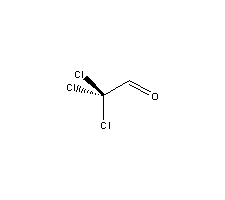
Product description:
What is the chemical of Chloral ?
Appearance: Colorless oily liquid, sometimes described as a volatile oily liquid with a spicy or irritating odor ;
Assay:99%min by GC ;
IR Identity: conform to standard ;
HNMR: conform to standard ;
carbon spectrum: conform to standard ;
Water by K. F.:0.5% max or as per the customer’s request ;
Loss on drying:0.5% max. or as per the customer’s request ;
=============================================================================
Trichloroacetaldehyde is one of the organic synthesis raw materials and an important intermediate for the production of pesticides and pharmaceuticals. In pesticides, it can be used to synthesize organophosphate insecticides dichlorvos and dichlorvos, organochlorine insecticides DDT, trichlorfon (mosquito and fly net), acaricide tricloside, and pyrethroid intermediate Dichloropyrethroid methyl (ethyl) ester.
In addition, it is used in medicine to manufacture chloramphenicol, streptomycin, and hypnotic agent chloral hydrate;
It can also be used as an organic raw material for the production of N, N-dimethylformamide, trichloromethane, and chloroform. The main use is for the manufacture of insecticides DDT, dichlorvos, dichlorvos, and herbicides trichloroacetaldehyde urea. It can also be used in the pharmaceutical industry and organic synthesis
=============================================================================
The synthesis of trichloroacetaldehyde includes ethanol chlorination method and acetaldehyde chlorination method. The main method used domestically is ethanol chlorination, which involves the reaction of ethanol with chlorine gas to produce a mixture of chloroacetaldehyde hydrate, chloroacetaldehyde hydrate, and chloroacetaldehyde, collectively known as chlorinated oil. The refined product of trichloroacetaldehyde can be obtained by reacting chlorinated oil with concentrated sulfuric acid and then using simple distillation. C2H5OH+Cl2+H2O → [80-90 ℃] CCl3CH (OH) (OC2CemicalbookH5)+CCl3CH (OH) 2 [+H2SO4] → [Reflux] CCl3CHO+C2H5OSO3H+H2SO4+H2O The by-product chloroethane can be packaged for pesticide production after water washing, alkali washing, drying, condensation, and distillation. Hydrogen chloride can be absorbed with water to produce 30% hydrochloric acid. Raw material consumption quota: 450kg/t ethanol (95%), 2000kg/t chlorine gas, 700kg/t sulfuric acid.


 Search Product