Anisyl alcohol
-
- Category :
Organic chemicals and Derivatives/Aroma compounds
- CAS NO : 105-13-5
- EC NO : 203-273-6
- Molecular Formula : C8H10O2
- Main Specifications : 99% min
- Synonyms : P-Anise Alcohol;P-Anisyl Alcohol;Anis;Anisy;Anisi;Benzenemethanol, 4-Methoxy-;4-Anise Alcohol;4-Anisyl Alcohol;4-Anisic Alcohol;(4-Methoxyphenyl)Methanol;Anisic Alcohol;Anise Alcohol;Anis Alcohol;Methoxybenzyl Alcohol;Methoxybenzylalcohol(4-);Fema 2099;4-Methoxy-Benzenemethano;4-Methoxybenzenemethanol;4-Methoxy-Benzenemethanol;Benzenemethanol,4-Methoxy-;P-Methoxy-Benzyl Alcohol;4-Methoxy-1,3-Benzothiazol-2-Amine;Anisyl Alcohol;P-Methoxybenzyl Alcohol;4-Methoxylbenzyl alcohol;Para Anisic Alcohol;PAAL;
Package: 25kg 50kg drum or bag
Uses : used in essence and spice and edible spices,and organic synthesis
Molecular Structure:
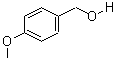
Product description:
What is the chemical of Anisyl alcohol?
Appearance: Colorless to pale yellow crystals. It has a sweet aroma of fennel, with a slight creamy and powdery background ;
Assay:99%min by GC ;
IR Identity: conform to standard ;
HNMR: conform to standard ;
carbon spectrum: conform to standard ;
Water by K. F.:0.5% max or as per the customer’s request ;
Loss on drying:0.5% max. or as per the customer’s request ;
Melting point: 22–25.5 °C;
boiling point: 259 ° C (at 760 mmHg);
==============================================================================
main purpose
Essence and spice: because of its sweet fennel aroma, it is widely used to prepare perfume, cosmetics and edible essence with jasmine, lilac, hawthorn flower, vanilla, chocolate, almond, peach and other scents.
Edible spices: comply with Chinese GB 2760-86 and GB 2760-1996 standards and are allowed to be used as edible spices.
Organic synthesis: As an important intermediate, it is used to synthesize drugs (such as cephalosporin intermediates), triphenylmethane dyes, and other fine chemicals.
Solvent: Used as a solvent or reaction medium in organic reactions.
===========================================================================
synthetic route
4-methoxybenzyl alcohol is mainly synthesized through the following methods:
Reduction method: It is produced by reducing p-methoxybenzal dehyde with a catalyst (such as NaBH ? or catalytic hydrogenation).
Konica reaction: Anisaldehyde (p-methoxybenzal dehyde) undergoes a dismutation reaction under strong alkaline conditions, producing 4-methoxybenzyl alcohol and the corresponding carboxylic acid.
Catalytic reduction: Formic acid is commonly used as a reducing agent in industry. In the presence of a catalyst (such as cat-1), the reaction is carried out in a 60 ° C aqueous phase for 12 hours. After extraction, drying, and column chromatography purification, high yields (>99%) of the product can be obtained.


 Search Product