Ammonium isovalerate
-
- Category :
Organic chemicals and Derivatives/Aroma compounds
- CAS NO : 7563-33-9
- EC NO : 231-458-1
- Molecular Formula : C5H13NO2
- Main Specifications : 99% min
- Synonyms : Ammonium isovalerate;AI3-36575;Ammonium 3-methylbutanoate;Ammonium isovalerianate;Butanoic acid, 3-methyl-, ammonium salt;FEMA No. 2054;Isovaleric acid, ammonium salt;3-methylbutanoic acid ammoniate (1:1);
Package: 25kg 50kg drum or bag
Uses : used as a flavor agent in food and essence industry
Molecular Structure:
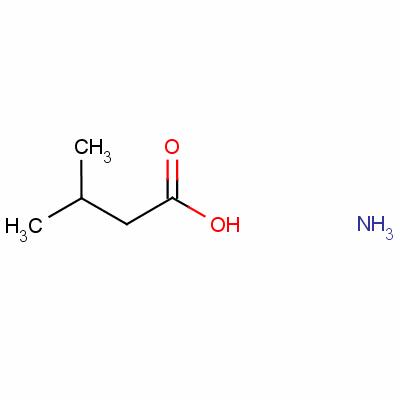
Product description:
What is the chemical of Ammonium isovalerate ?
Appearance: Colorless crystal or white to off white crystalline solid ;
Assay: 99% min by HPLC ;
IR Identity: conform to standard ;
HNMR: conform to standard ;
carbon spectrum: conform to standard ;
Water by K. F.:0.5% max or as per the customer’s request ;
Loss on drying:0.5% max. or as per the customer’s request ;
boiling point: 175.3 ° C (at 760 mmHg pressure);
============================================================================
Use: It is mainly used as a flavor agent in food and essence industry, which can enhance the aroma and taste of food, give the product fruit flavor, cream flavor or cheese like flavor, and is commonly used in baked food, candy and drinks. In addition, it is also used in the formulation of perfume and cosmetics
==============================================================================
Its synthesis can usually be achieved through acid-base neutralization reactions. The general idea is as follows:
Raw materials: 3-methylbutyric acid (isovaleric acid) is used as the raw material and reacted with ammonia water (NH ∝? H ? O) or ammonium hydroxide (NH ? OH).
Reaction equation:
(CH?)?CHCH?COOH + NH? → (CH?)?CHCH?COO?NH??
or
(CH?)?CHCH?COOH + NH?OH → (CH?)?CHCH?COO?NH?? + H?O
Process: Dissolve 3-methylbutyric acid in water or alcohol, slowly add ammonia water or ammonium hydroxide solution, control the pH value to neutral or weakly alkaline, the reaction releases heat and needs to be cooled. After the reaction is completed, the product can be obtained through methods such as solvent evaporation, crystallization, or drying.
Attention: Reaction conditions (such as temperature, concentration, pH) can affect the purity and yield of the product, and should be optimized according to experimental requirements. The product is a white crystalline solid that is easily soluble in water.
Due to the fact that 3-methylbutyric acid can be prepared by cyanide hydrolysis, hydrolysis, or fermentation of isobutyl halides, the synthesis route of this salt can be regarded as a two-step process: first prepare the acid, and then form the salt. However, the specific process parameters (such as catalyst, solvent, temperature, pressure) are not detailed in the existing data, and in actual production, reference should be made to professional chemical literature or patents


 Search Product