3-Mercaptopropionic acid
-
- Category :
Intermediates/Pharmaceutical intermediates
- CAS NO : 107-96-0
- EC NO : 203-537-0
- Molecular Formula : C3H5O2S
- Main Specifications : 99% min
- Synonyms : 3-Mercaptopropanoic Acid;Thiopropionic acid;Mercapto Propionic Acid;3-sulfanylpropanoic acid;3-sulfanylpropanoate;
Package: 25kg���,50kg 200kg
Uses : an important chemical intermediate and multifunctional reagent
Molecular Structure:
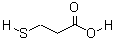
Product description:
What is the chemical of 3-Mercaptopropionic acid?
Appearance: Colorless to pale yellow transparent liquid with a strong sulfide odor ;
Assay:99%min by GC ;
IR Identity: conform to standard ;
HNMR: conform to standard ;
carbon spectrum: conform to standard ;
Water by K. F.:0.5% max or as per the customer’s request ;
Loss on drying:0.5% max. or as per the customer’s request ;
Melting point: 16-17℃;
boiling point: 110-111 °C/15 mmHg (lit.);
==================================================================
purpose
3-mercaptopropionic acid is an important chemical intermediate and multifunctional reagent, mainly used for:
Pharmaceutical intermediate: As a key intermediate for the synthesis of the drug Phenylbutazone.
Polyvinyl chloride (PVC) stabilizer: Similar to thioglycolic acid, it can be used for transparent PVC products and has excellent thermal stability, which is superior to other traditional stabilizers.
Antioxidants: Used to prevent oxidative degradation of polymer materials and chemicals.
Catalysts and biochemical reagents: used as catalysts or reaction reagents in organic synthesis and biochemical research.
Other applications: It is also used as an additive in the fields of electronic chemicals, building materials, and water reducing agents.
==========================================================
The common industrial process involves reacting acrylonitrile and thiourea as raw materials.
1. Raw material reaction: Reacte thiourea with hydrochloric acid at about 40 ℃ for a period of time, then add acrylonitrile dropwise and continue the reaction for several hours at 110-113 ℃.
2. Alkali treatment and dehydrogenation: After cooling the reaction solution, add sodium hydroxide solution to adjust the pH to alkaline and carry out dehydrogenation reaction.
3. Acidification and extraction: After dehydrogenation, neutralize with hydrochloric acid until acidic, and then extract with solvents such as benzene. four
4. Purification: After recovering the solvent, the final product of 3-mercaptopropionic acid can be obtained by collecting fractions within a specific temperature range through vacuum distillation.


 Search Product