2-Undecanol
-
- Category :
Organic chemicals and Derivatives/Aroma compounds
- CAS NO : 1653-30-1
- EC NO : 216-722-6
- Molecular Formula : C11H24O
- Main Specifications : 99% min
- Synonyms : 2-Hendecanol;2-Hydroxyundecane;Undecylic alcohol, sec-;2-Undecanol;
Package: 25kg���,50kg 200kg
Uses : As a food spice,
Molecular Structure:
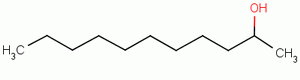
Product description:
What is the chemical of 2-Undecanol?
Appearance: colorless to almost colorless transparent liquid with a fresh, waxy, clean cotton and gentian like odor, and a waxy fragrance ;
Assay:99%min by GC ;
IR Identity: conform to standard ;
HNMR: conform to standard ;
carbon spectrum: conform to standard ;
Water by K. F.:0.5% max or as per the customer’s request ;
Loss on drying:0.5% max. or as per the customer’s request ;
boiling point: 130-131 ° C (at 28 mmHg pressure);
==============================================================================
Purpose:
As a food spice, it is used to prepare essence, and is allowed to be used in baked products. The maximum allowable amount is 20.0 mg/kg.
It is one of the components of volatile substances in Bacillus subtilis and has broad-spectrum antibacterial effects.
In nature, volatile compounds released by the tree sap beetle (Lobiopa insularis) and certain flowers can serve as pheromone components for Hymenoptera insects.
As an organic synthesis intermediate, used in industrial production
==============================================================================
Synthesis route: A known synthesis method is through fermentation production of Bacillus subtilis Jaased1 strain. The specific steps include:
Inoculate the strain into LB culture medium and shake at 37 ℃ and 120 r/min for 24 hours.
Place the culture at 50 ℃ and stir for 30 minutes to release volatile substances.
Collect volatile gases using solid-phase microextraction (SPME) technology.
Analyze and separate by gas chromatography-mass spectrometry (GC-MS)


 Search Product