2-Isopropyl phenol
-
- Category :
Organic chemicals and Derivatives/Aroma compounds
- CAS NO : 88-69-7
- EC NO : 201-852-8
- Molecular Formula : C9H12O
- Main Specifications : 99% min
- Synonyms : o-Cumenol;o-Hydroxycumene;2-(propan-2-yl)phenol;2-Isopropyl phenol;
Package: 25kg,50kg 200kg
Uses : an intermediate for the synthesis of isoprocarb
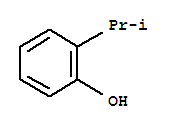
Molecular Structure:
Product description:
What is the chemical of 2-Isopropyl phenol ?
Appearance: Colorless to amber liquid ;
Assay:99%min by GC ;
IR Identity: conform to standard ;
HNMR: conform to standard ;
carbon spectrum: conform to standard ;
Water by K. F.:0.5% max or as per the customer’s request ;
Loss on drying:0.5% max. or as per the customer’s request ;
Melting point: 15℃-16℃;
========================================================
O-Isopropylphenol is an intermediate for the synthesis of isoprocarb. This product is a key intermediate for the carbamate insecticide, isoprocarb. It is also mainly used for the synthesis of isoprocarb
=========================================================
=============================================================================
(A) Production method: It is obtained through the alkylation reaction between phenol and propylene. Melted phenol is added to the reaction kettle, stirred, and heated to around 100℃. Aluminum is introduced into the phenol at a molar ratio of 1:0.0065-0.01 to phenol, and the temperature is further raised to 165-170℃. After reacting for half an hour, the phenol-aluminum solution is obtained. This phenol-aluminum solution is then transferred to an autoclave, stirred, and heated to 235℃. Liquid propylene is added to maintain a molar ratio of 1:0.65 between phenol and propylene. The reaction is carried out at 235-250℃ and 1.3-1.6MPa for one hour. After cooling, the reaction mixture undergoes primary distillation and rectification to collect phenol fractions and product fractions. The residual liquid at the bottom of the kettle is multi-alkylphenol. The phenol conversion rate is about 50%, the single-pass yield of o-isopropylphenol is 38-39%, and the single-pass yield of 2,6-diisopropylphenol is 10-11%. 2,6-Diisopropylphenol and phenol are mixed in a molar ratio of 1:3 and undergo disproportionation reaction at around 295℃ for two hours. The catalyst, phenol-aluminum, is used in an amount of 5-6% by weight in the reaction. About 75% of 2,6-diisopropylphenol is converted, with 90% of it being converted to o-isopropylphenol.
(B) Production Method: O-isopropylphenol is obtained through alkylation reaction between phenol and propylene. Melted phenol is added to a reaction vessel, stirred, and heated to around 100℃. Aluminum scraps are added to the phenol according to a molar ratio of phenol to aluminum of 1:0.0065~0.01, and the temperature is further raised to 165~170℃. After reacting for 0.5h, a phenol solution containing aluminum phenate is obtained. The phenol solution containing 3% aluminum phenate is placed in an autoclave, heated to 200℃ with stirring, and dried liquid propylene is introduced for alkylation reaction. The pressure inside the autoclave is controlled at 1.3~1.4MPa, and the temperature at 235~250℃. After the propylene is fully introduced, stirring is continued for 20min to obtain the reaction liquid. The single-pass conversion rate of phenol is controlled at around 50%, at which the selectivity of O-isopropylphenol can reach 80%. If the single-pass conversion rate of phenol is increased, the by-products 2,6-diisopropylphenol and polyalkylphenols will increase, resulting in a decrease in yield and posing difficulties for post-treatment.


 Search Product