2-Aminobenzothiazole
-
- Category :
Dyestuffs and Pigments
- CAS NO : 136-95-8
- EC NO : 205-268-4
- Molecular Formula : C7H6O3
- Main Specifications : 99% min
- Synonyms : 2-Benzothiazolamine;benzothiazol-2-ylamine;1,3-benzothiazol-2-amine;1,3-benzodioxol-5-ol;
Package: 25kg 50kg drum or bag
Uses : 2-Aminobenzothiazole is an important organic synthesis intermediate, belonging to fine chemical intermediates, and is widely used in the fields of dyes, pharmaceuticals, and scientific research.
Molecular Structure:
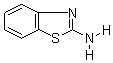
Product description:
What is the chemical of 2-Aminobenzothiazole ?
Appearance: White to pale yellow crystalline powder���;
Assay:99%min by HPLC;
IR Identity: conform to standard���;
HNMR: conform to standard��;
carbon spectrum: conform to standard��;
Water by K. F.:0.5% max or as per the customer’s request�;
Loss on drying:0.5% max. or as per the customer’s request;
==============================================================================
2-Aminobenzothiazole is an important organic synthesis intermediate belonging to fine chemical intermediates, with extensive applications in the fields of dyes, pharmaceuticals, and scientific research: In the dye industry, it serves as a key intermediate for synthesizing various cationic dyes; by synthesizing 3-methylbenzothiazolyl hydrazide, dyes such as Cationic Violet 2RL can be further prepared. In the pharmaceutical field, it is used as a pharmaceutical intermediate to synthesize drug molecules with biological activities such as antibacterial, antiviral, anti-inflammatory, or anticancer properties. In organic synthesis, it is used for the synthesis of other organic compounds and is an important raw material for constructing compounds containing benzothiazole structures.
============================================================================
Synthesis Route:
Raw Material Preparation: Use phenylthiourea and disulfur dichloride (also known as sulfur monochloride, S?Cl?) as starting materials.
Reaction Process:
Add anhydrous chloroform to the reaction釜, then add phenylthiourea under stirring. Slowly heat to 60-63°C to distill off water-containing chloroform. Cool to 40°C, add disulfur dichloride, control the vapor temperature not to exceed 40°C to prevent material lumping. After adding disulfur dichloride, gradually heat to 61°C over 4 hours, and reflux react at 61-64°C for about 10 hours.
Post-Processing:
After the reaction ends, discharge the reaction mixture into a distillation pot containing water and activated carbon. Distill off chloroform using direct steam until the liquid phase temperature reaches 98°C and is maintained for 15 minutes. After recovering chloroform, dilute with water and cool with ice. Neutralize with liquid alkali (sodium hydroxide solution) to a pH of 4.1, then add activated carbon and stir. After cooling and filtration, neutralize the filtrate again with 30% liquid alkali to a pH of 7.0-7.6. Finally, cool to 35-40°C, press-filter, dry at a temperature not exceeding 80°C, and obtain the finished product 2-amino benzothiazole.
Product Properties: The product obtained by this method has a melting point of approximately 128-130°C and a yield of about 74.4%.


 Search Product