1-Chloroctadecane
-
- Category :
Intermediates/Pharmaceutical intermediates
- CAS NO : 3386-33-2
- EC NO : 222-207-7
- Molecular Formula : C18H37Cl
- Main Specifications : 99% min
- Synonyms : 1-Chlorooctadecane;Octadecyl chloride;
Package: 25kg,50kg 200kg
Uses : as an intermediate in organic synthesis
Molecular Structure:
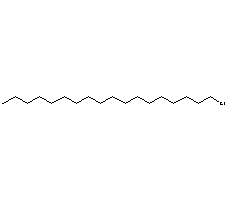
Product description:
What is the chemical of 1-Chloroctadecane ?
Appearance: Colorless to pale yellow liquid, transparent liquid or white solid ;
Assay:99%min by GC ;
Assay:99%min by Titration ;
IR Identity: conform to standard ;
HNMR: conform to standard ;
carbon spectrum: conform to standard ;
Water by K. F.:0.5% max or as per the customer’s request ;
Loss on drying:0.5% max. or as per the customer’s request ;
Melting point: 20-24°C;
=============================================================================
This compound is mainly used as an intermediate in organic synthesis and is widely used in fields such as pharmaceutical synthesis, surfactant raw materials, and octadecylating reagents; Specifically, it includes participating in fine chemical reactions as an organic reagent, as well as being used as a pharmaceutical intermediate in the pharmaceutical industry
==========================================================================
The main synthetic routes include:
Conversion of stearyl alcohol (112-92-5): Using stearyl alcohol as raw material, a substitution reaction occurs under the action of chlorination reagents (such as thionyl chloride or phosphorus pentachloride) to produce chlorooctadecane, with a yield of about 99%.
Decomposition of Octadecyl Chloroformate (51637-93-5): The target product is obtained by thermal decomposition or catalytic decomposition of Octadecyl Chloroformate, with a yield of approximately 91%.
Halogenation of Octadecylthiol (2885-00-9): Starting from Octadecylthiol, it is converted by chlorination with chlorine gas or thionyl chloride, with a yield of about 80%.
Reaction of 1-octadecylsulfonyl chloride: synthesis through substitution or reduction elimination of sulfonyl chloride groups, specific conditions need to be optimized.
Direct chlorination of n-octadecane (593-45-3): Chlorination reaction of n-octadecane under light or free radical initiator, but may be accompanied by polychlorinated byproducts.


 Search Product