1-Chloro-3-hydroxypropane
-
- Category :
Intermediates/Pharmaceutical intermediates
- CAS NO : 627-30-5
- EC NO : 210-992-9
- Molecular Formula : C3H7ClO
- Main Specifications : 99% min
- Synonyms : Chloropropanol,98%;Trimethylene chlorohydrin;3-Chloro-1-propanol;Chloropropanol;1-Propanol, 3-chloro-;3-Chloropropan-1-ol;3-Chlorpropan-1-ol;1-chloropropan-1-ol;1-Chloro-3-propanol;
Package: 25kg���,50kg 200kg
Uses : As a key intermediate for the synthesis of various drugs, such as clopidogrel (antithrombotic drug), nelfinavir (anti HIV drug), etc.
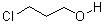
Molecular Structure:
Product description:
What is the chemical of 1-Chloro-3-hydroxypropane ?
Appearance: Colorless to light yellow transparent liquid, ;
Assay:99%min by GC ;
IR Identity: conform to standard ;
HNMR: conform to standard ;
carbon spectrum: conform to standard ;
Water by K. F.:0.5% max or as per the customer’s request ;
Loss on drying:0.5% max. or as per the customer’s request ;
Melting point: -20 °C;
boiling point: 160-162 °C;
============================================================================
Usage: Its main applications are concentrated in the fields of organic synthesis and pharmaceutical intermediates, including:
As a key intermediate for the synthesis of various drugs, such as clopidogrel (antithrombotic drug), nelfinavir (anti HIV drug), etc.
Used as a solvent in industries such as pharmaceuticals, dyes, fragrances, and pesticides.
Can be used as an emulsifier, thickener, and viscosity modifier.
Used for synthesizing other chemicals, such as 3-chloropropyl chloroformate
==============================================================================
Synthesis path:
Reaction of 1,3-propanediol with chlorinating agents: A common method is to use 1,3-propanediol (CAS: 107-10-8) to react with chlorinating agents such as thionyl chloride (SOCl ?) or phosphorus trichloride (PCl ∝), selectively replacing one of the hydroxyl groups with a chlorine atom to obtain 3-chloro-1-propanol. This method has relatively mild reaction conditions and high yield. one
Addition of epichlorohydrin and hydrogen chloride: Epoxypropane (CAS: 75-56-9) undergoes electrophilic addition reaction with hydrogen chloride (HCl) under acidic conditions, producing 3-chloro-1-propanol. This route has readily available raw materials and is one of the commonly used production methods in industry. one
Conversion from 3-chloropropyl compounds: Some synthetic routes start from 3-chloropropyl halides or thiols, introduce hydroxyl groups through hydrolysis or nucleophilic substitution reactions, and ultimately obtain the target product. For example, there are literature reports on the conversion of 3-chloropropanethiol as a raw material. one
Overall, there are more than 25 synthetic routes for 3-chloro-1-propanol, and the specific choice of route depends on factors such as raw material availability, cost, environmental requirements, and required purity


 Search Product