1,1-Di(2-methoxy ethoxy)ethane
-
- Category :
Intermediates/Pharmaceutical intermediates
- CAS NO : 112-49-2
- EC NO : 203-977-3
- Molecular Formula : C8H18O4
- Main Specifications : 99% min
- Synonyms : Acetaldehyde, bis(2-methoxyethyl) acetal;1,1-Di-(2-methoxyethoxy)ethane;2,5,7,10-Tetraoxaundecane, 6-methyl-;3-01-00-02651 (Beilstein Handbook Reference);BRN 1700623;Triethylene glycol dimethyl ether;Triglyme;dimethyltrigol;diethylene glycol monopropyl ether;1,2-bis-(2-methoxyethoxy)ethane;2,5,8,11-Tetraoxadodecane ansul ether 161;glyme 4 methyl triglyme dimethyltrigo;2,5,8,11-tetraoxadodecane;6-methyl-2,5,7,10-tetraoxaundecane;Triethylene glycol diemthyl ether;
Package: 25kg��,50kg 200kg
Uses : used as an organic solvent and has the following characteristics
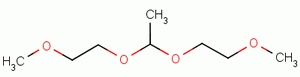
Molecular Structure:
Product description:
What is the chemical of Tetraethylene glycol dimethyl ether ?
Appearance: Colorless Transparent Liquid;
Assay:99%min by GC ;
IR Identity: conform to standard ;
HNMR: conform to standard ;
carbon spectrum: conform to standard ;
Water by K. F.:0.5% max or as per the customer’s request ;
Loss on drying:0.5% max. or as per the customer’s request ;
boiling point: 275-276 °C (lit.);
==============================================================================
In terms of usage, tetraethylene glycol dimethyl ether is mainly used as an organic solvent and has the following characteristics:
Solvent performance: It is a proton inert solvent that is completely water-soluble and commonly used in organic metal reactions or reaction systems containing alkali metals. It has excellent solubility for inorganic salts such as sodium borohydride and can be used as a substitute for standard solvents.
Industrial applications: Used as a co solvent to reduce the viscosity of prepolymers, or as a gas absorbent to purify acidic gases (such as synthesis gas, natural gas, acetylene).
Special fields: It also has applications in protein degradation targeted chimeras such as PROTAC Linkers.
Please note that this product should not be exposed to air for a long time to prevent the generation of peroxides
===========================================================================
The route mainly includes the following methods:
Crown ether method: Using cyclohexanone-15-crown-5 or 15-crown-5 as raw materials, alkylate with methyl iodide to generate the target product through nucleophilic substitution. This method utilizes the complexation effect of crown ethers to improve reaction selectivity. one
Glycyrrhetinic ether method: It uses n-butyl glycidyl ether or allyl glycidyl ether to react with 15-crown-5 and methyl iodide, and constructs ether bonds through epoxy ring opening and condensation processes, which is suitable for multi-step synthesis strategies. one
The method of using diethanol monomethyl ether: starting from diethanol monomethyl ether, it is first chlorinated with thionyl chloride to generate a chlorinated intermediate. At the same time, another part of diethanol monomethyl ether is converted to sodium alcoholate, and then condensed to form tetraethylene glycol dimethyl ether, which is purified by vacuum distillation. This route is direct and easy to scale up.


 Search Product