Chloramphenicol
-
- Category :
Pharmaceuticals and Biochemicals/Antibiotic and antimicrobial agents
- CAS NO : 56-75-7
- EC NO : 200-287-4
- Molecular Formula : C11H12Cl2N2O5
- Main Specifications : USP grade,Assay, % 99.2%
- Synonyms : chloramphenicol;2,2-dichloro-n-[2-hydroxy-1-(hydroxymethyl)-2-(4-nitrophenyl)ethyl]acetamide;d-(-)-threo-2,2-dichloro-n-[beta-hydroxy-alpha-(hydroxy-methyl)-p-nitrophenethyl]acetamide;chloromycetin;2,2-dichloro-N-[(1R,2S)-1,3-dihydroxy-1-(4-nitrophenyl)propan-2-yl]acetamide;2,2-dichloro-N-[(1S,2R)-1,3-dihydroxy-1-(4-nitrophenyl)propan-2-yl]acetamide;2,2-dichloro-N-[(1R)-2-hydroxy-1-(hydroxymethyl)-2-(4-;nitrophenyl)ethyl]acetamide;2,2-dichloro-n-(2-hydroxy-1-(hydroxymethyl)-2-(4-nitrophenyl)ethyl)-acetamid;Synthomycin;D,L-chloramphenicol;
Package: 25kg/fiber drum
Uses : Chloramphenicol is a broad spectrum antibiotic with good activity against Gram negative and anaerobic bacteria.
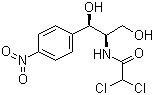
Molecular Structure:
Product description:
Chloramphenicol is unusual nitroaromatic metabolite produced by Streptomyces venezuelae, first published in 1947. Chloramphenicol is a broad spectrum antibiotic with good activity against Gram negative and anaerobic bacteria. Although restricted to ocular use, antibiotic resistance to other classes has refocused attention on this class. Chloramphenicol acts by binding to the 23S sub-unit of the 50S ribosome, inhibiting protein synthesis. Chloramphenicol has been extensively studied with over 35,000 literature citations.


 Search Product